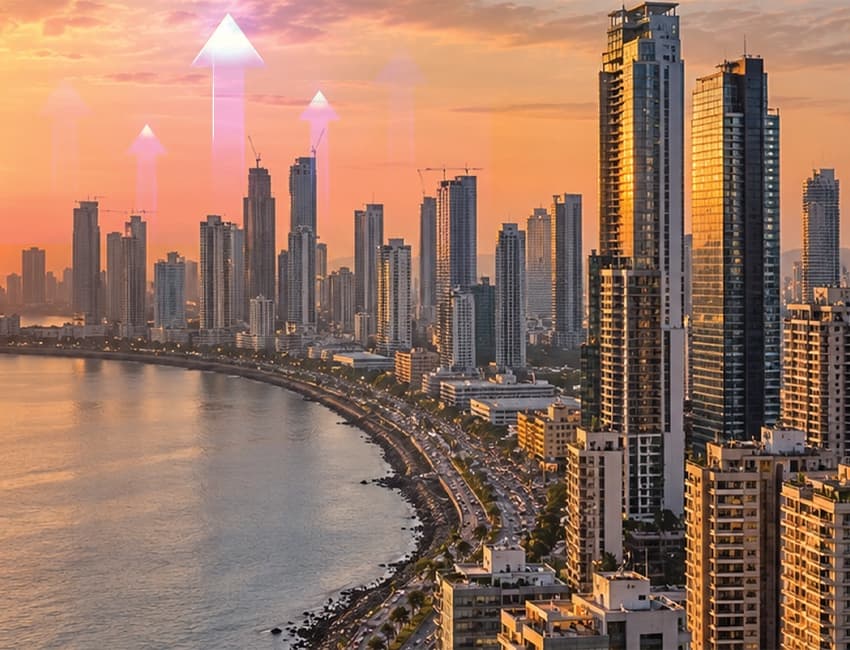
Mumbai is one of the world's leading locations in the premium residential property market, according to Knight Frank’s Prime Global Cities Index 2026 report. It states that Mumbai’s prime residential prices rose 6.2% year-on-year in Q2 2026.
The global average growth was 2.6% year-on-year, while Mumbai recorded a 1.7% rise quarter-on-quarter.
Bengaluru and New Delhi also featured among the top 20 global markets. Bengaluru recorded 4.5% annual growth (ranked 12th) and New Delhi recorded 3.9% (ranked 17th).
Mumbai is Considered as One of the World’s Prime Property Markets
According to the report, Mumbai’s prime residential market showed strength with a 6.2% year-on-year price rise.
Shishir Baijal noted that Mumbai has entered the global top 10 for prime residential price growth. Many established global markets recorded more moderate price growth than Mumbai.
Baijal explained that the price rise is demand-driven, supported by location, quality of construction, and limited supply of differentiated prime housing.
From Baijal’s perspective, prime residential property is appreciating and, in turn, creating wealth, and the supply of such property is restricted.
In addition to Mumbai, Baijal and Knight Frank India noted that Bengaluru and New Delhi also placed in the top 20 of the prime residential market.
This year’s report, Baijal added, illustrates that multiple Indian cities are represented in the global prime residential market.
Global prime residential prices rose 2.6% year-on-year.
The index shows that prime residential prices across 46 cities rose 2.6% in the 12 months to Q2 2026. This rate of increase was greater than that recorded in the previous quarter, which was 2.0%.
The index is compiled by tracking 46 of the largest cities throughout the world, and for the current period, 32 of these cities showed an increase in prices for prime residential properties, while 15 showed a decline in prices.
During the previous quarter, 25 cities showed an increase in prices, while 18 showed a decline, and one was unchanged.
Based upon the information provided, there continue to be disparate conditions in the prime residential markets of the world. Local conditions of the economy and supply of residential property, as well as interest rate differentials and investment conditions, often explain the variations.
Tokyo the Best Performer
During the year to the second quarter of 2026, the prime residential market in Tokyo showed the best performance among the cities covered by the index. During this period, prices increased by 50.7% and by 12.6% during the previous quarter.
For the year to the same quarter, the prime residential market of Manila showed an increase of 14.6% and thereby ranked second among the cities covered by the index.
Prime residential prices in the city of Dubai showed an increase of 10.9% for the year to the second quarter of 2026 and therefore ranked third among the cities covered by the index. Prime residential prices in Singapore for the same period increased by 9.5%.
European Markets Present Divergent Data
Performance in markets outside of Asia showed more divergence.
Vienna recorded 5.9% annual growth and ranked 9th. These markets are still positive, but showed less growth compared to the best-performing markets of the year.
Beijing recorded the steepest decline of 8.4%.
Following Beijing was Toronto, showing a decline of 7.3%, and Wellington, showing a decline of 5.4%. The prime residential market of London also showed negative growth, with a decline of 3.6% for the year.
Divergence in the same markets, and exposure to the same economic conditions, shows localized conditions are more relevant in describing prime residential markets.
Local Conditions Impact Premium Housing Markets
According to Knight Frank, while some consistency is shown in global prime housing markets, many still demonstrate little correlation to one another.
Liam Bailey, Global Head of Research at Knight Frank, said that more and more cities were showing house price appreciation, and that the annual rate of appreciation was accelerating. He also noted that the recovery that began in the gateway markets had spread to the regional markets.
Bailey claimed that local market conditions would determine the direction of global prime residential prices. Factors such as domestic monetary policy, demographics, and wealth creation would all impact prices.
Mumbai ranked among the strongest markets with 1.7% quarter-on-quarter and 6.2% year-on-year growth.
The emergence of Mumbai, as well as Bengaluru and New Delhi, illustrates that other major Indian cities are crossing over into the world of international luxury housing. The presence of Indian cities in the top 20 list shows that the world’s perception of the Indian prime housing market has changed.
Read More - Mumbai, BMC's Improvements Committee Clears Proposal to Allow High-Rise Buildings on Narrow Roads
Source- Hindustantimes