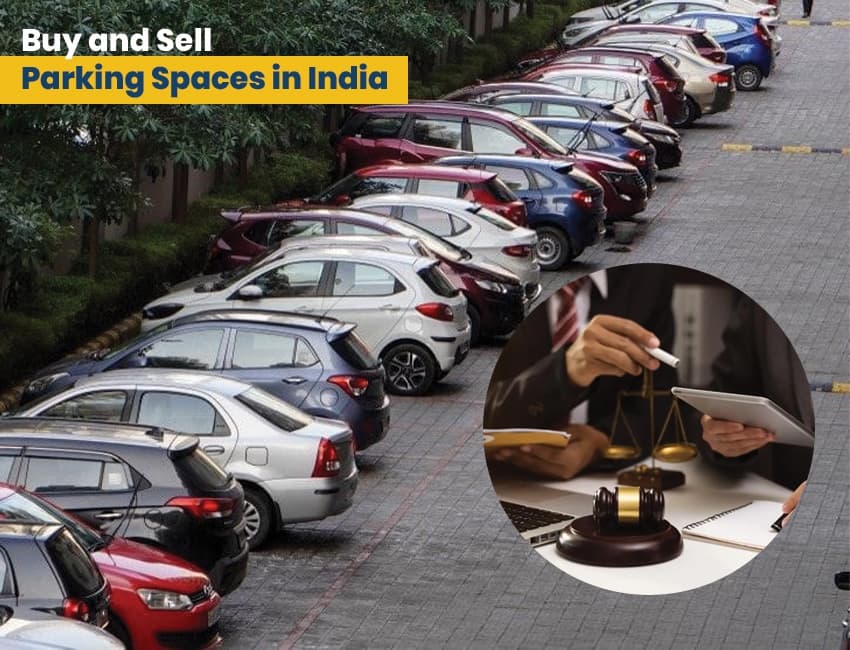
In India, parking regulations differ substantially from those governing flats and shops. However, the decision made by a Chinese court concerning parking as an investment opportunity has generated considerable interest.
A Chinese Court Backs a Bulk Parking Buyer
The woman who is being referred to as “Wu” purchased 196 parking spaces from a residential development in Changsha (Hunan Province), which reportedly cost her approximately ₹20 crores. Wu intends to receive rental income for these spaces, and then sell them at a higher price than what she paid. This has caused many Indian real estate investors to question if parking spaces can be purchased and sold like other types of properties such as apartments, office buildings and retail outlets.
As reported by the South China Morning Post, the local courts agreed with Wu’s position in February of 2024 and stated that purchasing parking spaces in bulk is legal. This ruling is the final answer to the resident’s claim that Wu was able to take over the parking market for financial gain.
How the Investment Played Out?
In 2018, when the housing development hit the market, there was low demand for both apartments and parking spaces due to a lack of shops, schools, and public transportation options in the immediate vicinity. Wu made an investment in the parking spaces during this low-demand period, with the expectation that the surrounding community would grow.
Her bet paid off. When the area developed further and more homes were purchased, there was less space available for parking. To prevent unauthorized vehicles from using her spaces, Wu installed locks on them. At that point, she began renting them for 500 yuan (approximately $75) each month, which was double the price that the developer charged in 2018. Although some residents asked her to lower the monthly rental fee to 300 yuan, she refused.
She eventually sold these spaces for approximately 100,000 Chinese Yuan (or $15,000 U.S. Dollars), with some selling for as much as 80% higher than what they had initially been priced. Residents who were unable to locate parking protested and claimed that she was creating a monopoly on parking spaces.
Why the Court Ruled Against the Residents?
The court noted that although residents could have purchased these parking spots at the time the developer initially made them available for sale, none did. However, unlike other residents, Wu was willing to invest in a market with low demand and take on the risks associated with such investments.
Furthermore, the judges stated that there is nothing in Chinese law that prohibits an individual from owning as many parking spaces as he/she wishes.
The Indian Question: Is Parking an Independent Asset?
Experts are saying that although there is no federal law limiting the number of parking spaces you can have in India, as opposed to China, this does not mean that every space is eligible to be bought, sold, or leased as an independent investment.
Shiraj Shalelkar, Senior Partner at ANB Legal, said that the numerous statutory provisions regarding parking within residential developments will generally render commercial exploitation of parking spaces by third parties impossible.
Maharashtra: Open and Stilt Parking Cannot Be Sold Separately
Under the Maharashtra Ownership Flats Act, 1963 (MOFA), a builder can only sell an apartment or a shop. An open or stilt parking area is not considered to be a saleable unit. The Supreme Court of India has ruled in its 2010 judgment in Nahalchand Laloochand Pvt Ltd vs Panchali Cooperative Housing Society that builders cannot sell such parking areas as independent units.
That position, according to Shalelkar, has been maintained since the Real Estate (Regulation and Development) Act of 2016, also known as RERA, was implemented.
Planning regulations reinforce this. According to the Development Control and Promotion Regulations for Greater Mumbai, 2034 (DCPR), developers must provide a certain number of parking spaces for every apartment based upon its size. Only after fulfilling these requirements can a developer dispose of any unused parking spaces. At that time, the legal experts point out, a developer may charge residents a fee to use the unused parking space, but may not sell the space.
One method exists for transferring ownership of a parking space to another resident. Residents of a housing society are allowed to transfer ownership of their parking space to another resident within that housing society through either sale or lease.
Garages Follow Different Rules
There are no such limitations on garages as mentioned above. A garage is defined by Section 2(y) of RERA as a covered area in the project, having a 3-sided wall, used for parking a vehicle. It can be declared as a separate saleable unit under the Act. Hence, there is no restriction on the number of garages that can be sold by the developer/builder to one purchaser; therefore, it could be an investment option; however, other types of parking like open/stilt parking may not be.
Once the Society Is Formed, the Builder Loses Control
Once a project has been completed, control of unallotted parking will transfer. At this time, the Co-operative Housing Society will be officially recognized as such, and the project will have officially transitioned into the hands of the society. After both of these events occur, the builder will no longer possess the legal right to assign or manage the available parking spaces. Any additional spaces that were not assigned to any of the individual buyers of flats shall fall under the jurisdiction of the society’s Managing Committee and General Body, each of which must operate within the confines of the society’s Bye-laws.
According to Shalelkar, under the Maharashtra Model Bye-laws for Cooperative Housing Societies, each member will generally have the right to use just one parking space. If there are still empty spaces available within the parking lot after all members have been assigned a minimum of one space, those extra spaces can be given to members who currently use a single space. These extra spaces will be granted for one year at a time.
What This Means for Indian Real Estate Investors
For those wanting to use the “Changsha strategy” in other Indian cities, there are few legal options. In brief:
Open & Stilted Parking: Developers in Maharashtra cannot sell open and/or stilted parking spaces as separate units. At most, a developer may provide additional parking space for purchase after meeting all statutory provisions.
Garages: Garage spaces defined as separate units in RERA can be purchased by an individual with no restrictions on the number of such units that they can acquire.
Society-owned parking spaces are allotted by the society after handover, according to the society’s bye-laws. Generally, these bye-laws provide each member with one parking space.
Member-to-member transfer: A society member may sell/license their space to another society member; however, this cannot be used as a means for an external investor to acquire a space.
The rules for parking are different in each state and by each local authority. The Maharashtra model explained above may be irrelevant in other areas. Therefore, investors must review the project’s sanction plan, the sales agreement, RERA registration data, and the society’s by-laws prior to investing funds, and they need to seek advice from an experienced real estate attorney.
conclusion
The decision made by China’s court system shows that if you make an early and patient investment in parking, you may eventually be able to make money from it, as long as your country’s laws allow it. However, in India (especially in the state of Maharashtra), parking is usually attached to each flat and is regulated by both the city’s planning laws and the society’s bylaws. Except for the enclosed garage, which can be considered a separate unit, most other parking spaces do not function like flats or shops as liquid assets that can be easily bought and sold.
Read More: NBCC Floats Tenders Worth ₹9,620 Crore for Completion of 16 Stalled Supertech Projects
Source: Hindustan Times