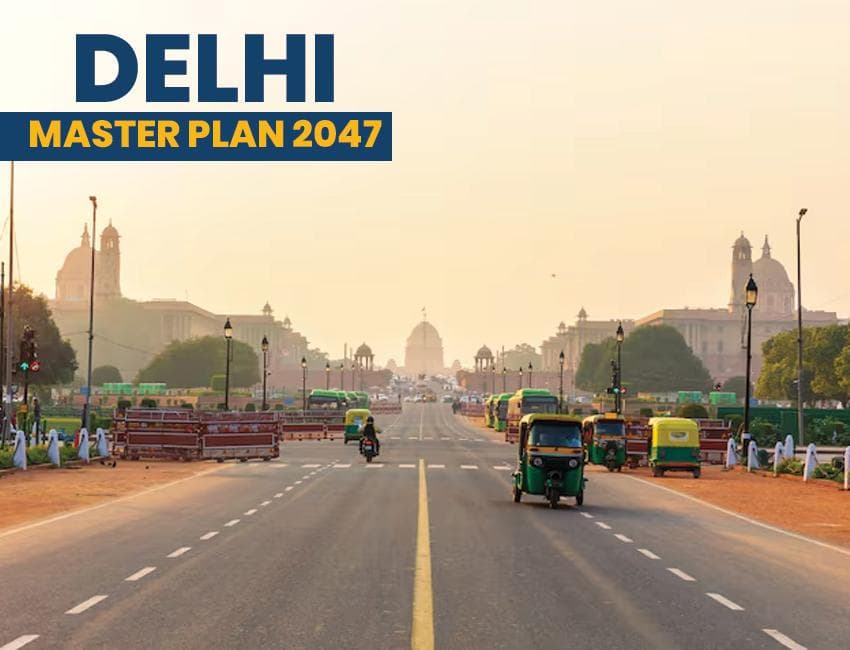
New Delhi: The real estate market in Delhi could begin a new phase, as the Delhi Master Plan 2047 (MPD 2047) sets out a long-term plan for housing, redevelopment and mobility, and urban expansion.
The move is being implemented at a time when property prices across the National Capital Region have risen significantly, and buyers are increasingly comparing Delhi with Noida, Greater Noida and Gurugram before deciding to purchase.
One of the most important questions concerning buyers in the NCR housing market involves whether a greater housing stock inside Delhi will decrease demand in nearby cities.
The answer may not be as simple as a straightforward shift of customers from Noida and Gurugram returning to Delhi.
However, it is possible that MPD 2047 may result in a more segmented NCR housing market in which different markets attract buyers based on accessibility to employment, affordability, and size of the property as well as lifestyle and connectivity.
Delhi's Housing Requirement Could Create a New Supply Cycle
Delhi is expected to accommodate a population of around 32 million in 2047. This will result in an enormous need for more housing. The master plan will provide nearly four million more homes to cater for the city's future housing needs.
The plan does not rely solely on developing vacant land
The strategy is comprised of:
- Land pooling and planned development, as well as planned development
- Redevelopment of old residential areas
- Higher-density development
- Transit-Oriented Development (TOD)
- Affordable rental housing
- Redevelopment of unauthorised and undeveloped areas
- More efficient use of under-used urban land
This method could slowly increase the number of housing options in Delhi, particularly for those with middle incomes and who are price sensitive.
The eventual impact will be heavily dependent on the way in which it is implemented.
Will Buyers Currently Considering Noida Return to Delhi?
Noida as well as Greater Noida have become important options for Delhi homeowners due to the fact that they have plans for sectors, more modern residential developments, and a broader selection of apartment styles.
If Delhi has a significant supply of homes at competitive prices with high connectivity, people who are looking at Noida or Greater Noida could reconsider Delhi.
But a major reverse migration isn't likely to occur in the near future.
The reason for this is that buyers are not able to choose an item based solely on the price.
The location, proximity to work, the size of the home, the infrastructure, amenities, parking, and the future growth prospects affect the choice.
For instance, a person seeking a smaller or mid-income house might consider the new Delhi developments appealing. Those who want the largest three- or four-bedroom house in a gated community that offers numerous amenities might want to look at Noida and Gurugram.
Delhi's New Supply May Compete With Some Segments More Than Others
The most crucial factor will be the type of housing Delhi adds to the market.
The master plan puts enormous importance on affordable rental accommodations as well as redevelopment and smaller housing sizes. Recent reports regarding MPD 2047 also recognize the significance of smaller houses as well as rental housing and development in meeting the city's housing needs.
This may lead to a greater level of competition for mid- and affordable housing in areas like Noida along with Greater Noida.
The effect on luxury homes is, however, significantly less.
High-end buyers usually are looking for things like huge floor plans, well-known developments, clubhouses and green spaces, as well as private amenities and closeness to established business hubs.
These needs are well-represented by Gurugram and Noida's top residential market.
Gurugram's Corporate Ecosystem Provides a Strong Demand Anchor
Gurugram's real estate market has expanded beyond its role as an extension of Delhi.
The city has emerged as a key corporate and employment center with a growing demand for residential housing, fueled by multinational corporations' offices, office areas, and high-end commercial developments.
Knight Frank's H1-2026 research indicates the fact that Gurugram continues to be one of the NCR's most thriving residential markets. The study found an average price for residential properties of approximately Rs 18,354 per sq feet in H1 2026, with prices increasing by 6 percent year-on-year.
The city's needs are growing more diverse through corridors like Dwarka Expressway, New Gurugram, and other premium areas that are well-established.
Delhi's upcoming housing market will have to provide more than competitive pricing in order to significantly shift the demand for housing in Gurugram that is tied to employment.
Noida Also Has Its Own Growth Drivers
Noida's residential market has also established its own market demand.
The city is benefiting from planned infrastructure, commercial development, increasing job opportunities, and a better regional connection.
Knight Frank's H1-2026 data estimated Noida's median residential cost at about Rs 15,109 per sq feet, which is an annual increase of 8. The report also revealed an inventory ratio that was lower when compared to Gurugram and indicates a steady absorption of demand.
The growth of the region, which is dominated by the airport in the vicinity of Noida International Airport, will be yet another reason that has boosted investor and end-user attraction to the Greater Noida market.
So, more Delhi housing might influence buyer selections in specific segments, but it's unlikely to eliminate the primary demand drivers driving Noida.
Property Prices May Not Fall Just Because Supply Increases
The most common belief is that if Delhi is able to build millions of homes and properties, the property prices for Noida as well as Gurugram will naturally come under pressure.
The real estate market generally does not work like that.
Prices are influenced by a variety of aspects, including:
- New housing supply
- Buyer income levels
- Employment growth
- Infrastructure development
- Land availability
- Costs of construction
- Rates of interest
- Investor participation
- Demand for specific locations
- The quality of residential developments
If Delhi expands housing at the same level as local demand, then the new inventory could just be able to meet the needs of the growing population, rather than removing current buyers from the NCR market.
This distinction is vital.
The requirement of four million homes projected under MPD 2047 is indicative of Delhi's upcoming housing needs, but it doesn't mean that four million homes will be available in the market, or directly compete with homes in Noida as well as Gurugram.
MPD 2047 Could Create New Real Estate Corridors Within Delhi
One of the more long-term effects that the master plan will have could be the development in new zones for development.
Land pooling, higher-density development, and transit-oriented growth can increase the appeal of areas which currently have a limited amount of housing activity.
The plans' focus on vertical development and high-density corridors may enable Delhi to make use of its limited area more efficiently. Areas linked to major transportation corridors may be increasingly important to both developers and homebuyers.
This could change the Delhi-NCR property map in the future.
Instead of the demand being concentrated in well-established South Delhi, West Delhi, or central areas, new urban areas could develop in the city's upcoming zones.
Connectivity Will Decide How Strong the Competition Becomes
The availability of housing will not decide whether Delhi is able to draw purchasers coming from Noida as well as Gurugram.
The importance of connectivity will be equally significant.
A reasonably affordable house will be less appealing when residents are required to spend time traveling to work.
This is the reason why Noida and Gurugram are currently enjoying a major advantage over other cities in their established employment corridors.
MPD 2047 is a major focus on enhancing urban mobility and integrating multiple transportation systems. The larger plan also plans for the massive growth of the Delhi Metro network by 2047.
If new areas of residential development are constructed alongside well-functioning public transport, as well as employment centers, their ability to compete in a competitive manner with the NCR market could be significantly enhanced.
Affordable Housing Could See the Biggest Shift
In all segments, low-cost and middle-income housing can experience the greatest impact.
The Delhi resident who has chosen Greater Noida because of comparatively affordable housing costs may be able to choose another alternative if similar houses become available in Delhi with greater accessibility to public transport and employment.
This could create more competition between certain Delhi or Greater Noida micro-markets.
But the results will differ from location to location.
A new project for housing located in an unconnected area is not likely to compete against a well-established project with better infrastructure, schools, retail and office spaces, as well as transportation.
Gurugram's Luxury Market Could Remain Relatively Insulated
Gurugram's high-end residential market is expected to be less prone to Delhi's housing affordability expansion.
The city has developed an exclusive luxury environment that is centered around workplaces for corporations and residential corridors with premium amenities.
Luxury developments, large-format apartment integrated communities, and premium commercial areas cater to those who are looking for more than getting a decent home.
This means the direct competition to Delhi's affordable and small housing stock is small.
However, Gurugram's future success will depend on expansion by the company, infrastructure projects, and premium launches. Buyers with high incomes.
What It Means for Property Investors
MPD 2047 is likely to alter the way that investors assess the emerging properties in Delhi.
Instead of focusing solely on the price of property at present, investors are now able to evaluate:
Potential for development: Whether land can be used for redevelopment or construction with higher density.
Connectivity: Proximity to Metro corridors, major roads, as well as future infrastructure for transport.
Work: Access to established and emerging job centers.
The demand for homes: Whether a location is a good fit for low-cost, middle-income, or renters, or even the most expensive buyers.
Infrastructure preparedness: Whether roads, public transport, schools, and other municipal facilities are able to support the growth of future populations.
Development rights: The impact of land-pooling, FAR, and other rules could impact future development opportunities.
Investors must be aware of the difference between the general policy directive and the actual development permits for projects. Implementation of planning regulations will determine the speed at which the individual sites will gain.
Delhi, Noida and Gurugram Could Become More Differentiated
Instead of causing an open fight between the three market segments, MPD 2047 may actually cause their differences to be more prominent.
Delhi might enhance its position in rental accommodations, redevelopment, as well as transit-linked development of residential properties.
Noida as well as Greater Noida could continue to draw buyers seeking planned communities, better housing options, more spacious apartment buildings, and infrastructure-driven growth.
Gurugram may remain concentrated on the demand for housing by corporates, luxurious residences, luxury homes, and premium developments.
This could enable each of the three markets to increase, but the pace of growth might differ among specific locations and property types.
The Bigger Impact May Be on Buyer Choices, Not Property Prices
The true effect of MPD 2047 will be felt in the way that buyers evaluate residential markets.
A person who had only a few viable choices could now have more options in Delhi itself. However, Noida and Gurugram will continue to provide housing options and employment networks that Delhi might not be able to replicate across all places.
In the case of developers, this might result in a greater emphasis on specific products for a particular location instead of simply boosting supply.
For potential buyers, it could lead to more competition in the NCR market, with a greater choice of housing options.
As for investors, the most important question could change away from "Which city will outperform?" to "Which micro-market and housing segment will benefit from the next phase of infrastructure and employment growth?"
A Reshaped NCR Market, Not Necessarily a Price Correction
Delhi Master Plan 2047 has the potential to significantly increase the housing capacity in the capital in the coming two decades.
However, its impact on Noida and Gurugram property prices is not likely to be instantaneous or uniform.
The most significant competition is likely to emerge in the housing market for low- and middle-income households, especially in areas where the latest Delhi developments are able to provide strong connectivity and affordable prices.
High-end housing in Gurugram and well-established areas of residential development in Noida will likely be driven by job infrastructure and lifestyle benefits.
In the end, MPD 2047 may increase the number of homes available in the NCR instead of triggering a straightforward shifting of people from one place to another.
As the implementation process progresses, the market for real estate will continue to be influenced by a mix of supply and demand for housing, transportation connectivity, growth in employment, and the kind of homes being constructed.
For Delhi, the main problem will be in transforming plans into real construction and housing on the ground. In the case of Noida and Gurugram, the main issue will be preserving their advantages in the market as capital is creating new residential options.
It could result in a more diverse NCR property market, where Delhi, Noida and Gurugram have a chance to compete in particular categories while still complementing one another in others.
Read More: UP Government Approves 73,184 New Houses Under PMAY-Urban 2.0
Source: Hindustan Times